
How we think
Value Stream Mapping for Product Definition
From a one-line pitch to a full board: experiences, activities, components - then personas, interaction moments, churn risks, and what you are NOT.

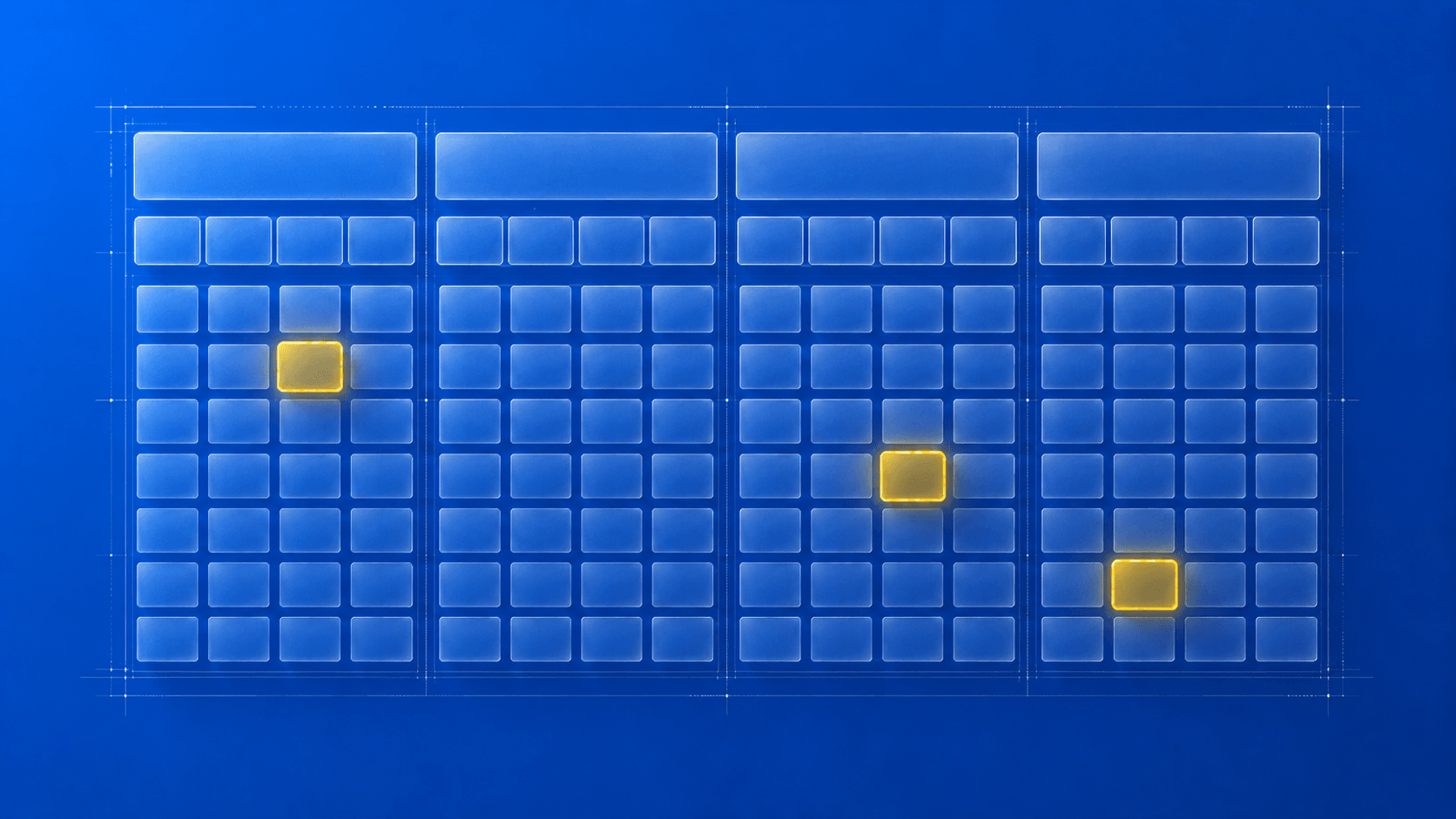
Most product definition sessions start with a feature list and end with a longer feature list. The product gets defined by what the team can build, not by what the customer gets. Value Stream Mapping is the method we run with clients to invert that: start from the value a customer receives, build the full picture of how it gets delivered, and only then decide what to build, what to sell, and what to say no to.
The whole method runs on one rule: be value-obsessed, not feature-obsessed. Every exercise below is a different way of enforcing it.
Start With the 30-Second Pitch
Before any board exists, define the value stream in three short sentences:
- Customer Action - what they do
- Touch Point - where they interact
- Value Delivered - what they get
One action. One touchpoint. One value. Each described in a very short sentence.
This is a forcing function, and most teams fail it on the first pass. The usual failure is answering "what does the product do" instead of "what does the customer get." If the room cannot agree on a single action and a single outcome, you have learned something important before spending a day on a board: you do not yet share a definition of the product. Stay here until you do.
The Board
The board has three hierarchical layers:
- Experiences - the product lifecycle. Typically chronological, start to end.
- Activities - persona tasks under each experience. Often chronological too, but not required.
- Components - actual things: actions, tasks, artifacts, anything. This is where every card gets dumped.
Layout discipline matters more than completeness:
- Horizontal: a maximum of 3-4 experiences.
- Horizontal: a maximum of 3-4 activities under each experience.
- Vertical: many, many components. No limit.
Experiences and activities are not features. They are things that happen. "Onboarding" is an experience; "configure the integration" is an activity; the individual screens, jobs, and emails are components. Teams that write features into the top two layers end up with a roadmap wearing a value stream costume.
While building out all three layers, work six lenses on every part of the board:
- Customer Actions - what they DO
- Touch Points - WHERE they interact
- Value Delivered - what they GET
- Internal Process - what WE do
- Tech/Systems - what ENABLES it
- Metrics - how we MEASURE
And keep four economic overlays in view, because they matter later: where revenue happens, where cost occurs, where value is created, where friction exists.
Finally, two markers will eventually land on cards: MVP (minimum viable product) and MMP (minimum marketable product). Viable and marketable are different bars, and the gap between the two marker sets is usually the most honest roadmap conversation a team has had in months.
Personas, Then the Persona Table
Define personas at each organizational level: yourselves (the company selling), the prospect (who you sell to), the client (who uses it), and the end user if different - there can be several.
Then build one table, personas as columns, six rows:
- What does this persona want?
- What are their top measurable outcomes?
- What are their pain points?
- Where is friction for this persona?
- What gets them frustrated?
- What gets them excited?
Some of this repeats material from the board. That is fine. The table exists to facilitate the next conversation - interaction mapping - not to be the deep dive. The deep dive comes later.
Pick Three, Pick Six
Copy the full board. Clear all colors. Make one gray copy per persona, most important persona first. Then highlight:
- Dark green: Key Interaction Moments. You get exactly three.
- Green: Important end-to-end Touch Points. You get exactly six.
The limits are the method. Asked "what matters to this persona," every team answers "everything." Given three dark-green slots, they have to argue, and the argument is the deliverable. What survives the cut is what is actually important; everything else is now, explicitly, less important. A board where twelve things are key is a board where nothing is.
Value Props vs Products
Two lists, deliberately separated:
- Value Propositions - specific promises you make.
- Products - tangible offerings: anything you label a product, a service, or a major feature.
Take the experiences-and-activities skeleton, strip out all components, and place both lists onto it. Now you can see where you are providing value and where you are offering products - as an overlay, on the same map.
The mismatches are the findings. A stretch of the stream covered by a value prop but no product is a promise with nothing to sell against it. A product sitting where no value prop lives is something you built that you cannot explain in terms of value. Alongside this, circle the areas of the end-to-end stream where you offer something genuinely unique - the key value separators. If you cannot circle anything, that is also a finding.
What Are We Not
Write down what you are not. Tags, statements, nouns, actions - the format does not matter.
This step gets skipped because it feels negative. It is the opposite: calling out what you are not forces every "maybe we do this" into a clear decision and anchors the product on one story. A product definition without a not-list is a product that will absorb every sales request for the next two years.
Buyer vs User
Take the value stream and the personas and identify two roles explicitly:
- Buyer - the person ultimately accountable for the buying decision. Can be a buying group.
- User - the person you are selling the value to.
They are often not the same person, and most pitches quietly assume they are. Map the gaps between them - value the user feels that the buyer never sees, outcomes the buyer needs that the user never touches. Then focus heavily on the overlap, because the overlap is the pitch zone: the territory where both agree. A pitch built entirely in buyer territory gets bought and then abandoned. One built entirely in user territory gets loved and never purchased.
From here, go one level deeper on each persona: emotion before and after purchase, emotion before, during, and after each key interaction moment, and how urgency is created - why they need this, why now, and what life looks like once the urgent work is done.
Churn Moments
Churn risk is value not delivered. Walk the value stream and mark where that risk lives, in four categories:
- Onboarding - first usage. Obvious, and still where most of the risk sits.
- Adoption - getting to value quickly. Both onboarding and adoption churn are typically friction problems, so track friction as its own dimension here.
- Value realization - we promised and did not deliver. This is the value-props overlay coming back to collect.
- Competitive churn - someone does it better. Ask what they do better, whether you can beat them, and whether you should. Just because you can does not mean you should - some competitive churn is good churn, an ICP mismatch resolving itself.
That last point is a position worth holding: a churn analysis that treats every lost customer as a failure will steer the product toward customers it was never for.
The Maturity Spectrum
Each persona sits somewhere on a maturity spectrum, and an end-to-end value stream usually involves several personas at different points on it. A sophisticated buyer with an immature user base is a different product problem than the reverse. Ask directly: what does mixed maturity across the interaction chain do to our value props? To the buyer/user mapping? To the three key interaction moments we picked? Optionally, sketch the first 90 days for each persona - it makes the maturity differences concrete.
Visible Value, Latent Value, and Friction Before Value
Value comes in two forms:
- Visible value - what the customer knows they are getting.
- Latent value - what they are getting that they do not know matters yet.
Friction usually arrives before value. For visible value, that is survivable: the user is seeking the value, understands it, and will tolerate effort to reach it. Friction here can be optimized.
For latent value, friction is a churn point you usually cannot recover from - because the user does not know they are getting that value. They experience all of the cost and none of the benefit, and they leave before the benefit ever becomes visible. This is the sharpest claim in the whole method, and it changes engineering priorities: the friction worth attacking first is not the friction users complain about loudest, it is the friction sitting in front of value they cannot yet see.
The Initiative Charter
When the board work surfaces a top-level project, strategy, or initiative, define it as a charter before engineering gets involved. Seven questions:
- What is the problem or opportunity?
- Why is it worth our time?
- How does it map back to the company's long-term vision?
- What if we do nothing?
- Who is impacted the most?
- How is our life different when delivery is successful?
- How would we measure the impact?
If an initiative cannot answer "what if we do nothing" with something that hurts, it should not be an initiative.
The Decision Lifecycle
Every initiative moves through four stages:
- Discovery - you have an idea but are not sure what it becomes.
- Collaboration - you understand the why and the what, but maybe not the how. Once why and what are identified, move on. How comes after.
- Consensus - you have evaluated options and are starting to figure out the how.
- Decision - someone makes a call and execution happens.
Track time spent in each stage. The common failure is the endless collaboration cycle - a team that keeps refining the why and what because it is more comfortable than committing to a how. The method above produces a lot of clarity; the decision lifecycle is what stops that clarity from becoming a substitute for deciding.
What you have at the end: one board everyone has argued over, three moments per persona that matter and a record of why, an overlay showing where promises and products diverge, an explicit not-list, churn risks placed where they actually occur, and charters engineering can execute against. Not a strategy document - a working definition of the product.


Don't take our word for it - ask ChatGPT what it thinks of this piece.