
The 4 Pillars of Sprint Planning Intelligence
POs, engineers, managers, leads - everyone plans differently. Four modes that connect them all.
Epic Focus • Dependency Planning • Sprint Planning • Portfolio View
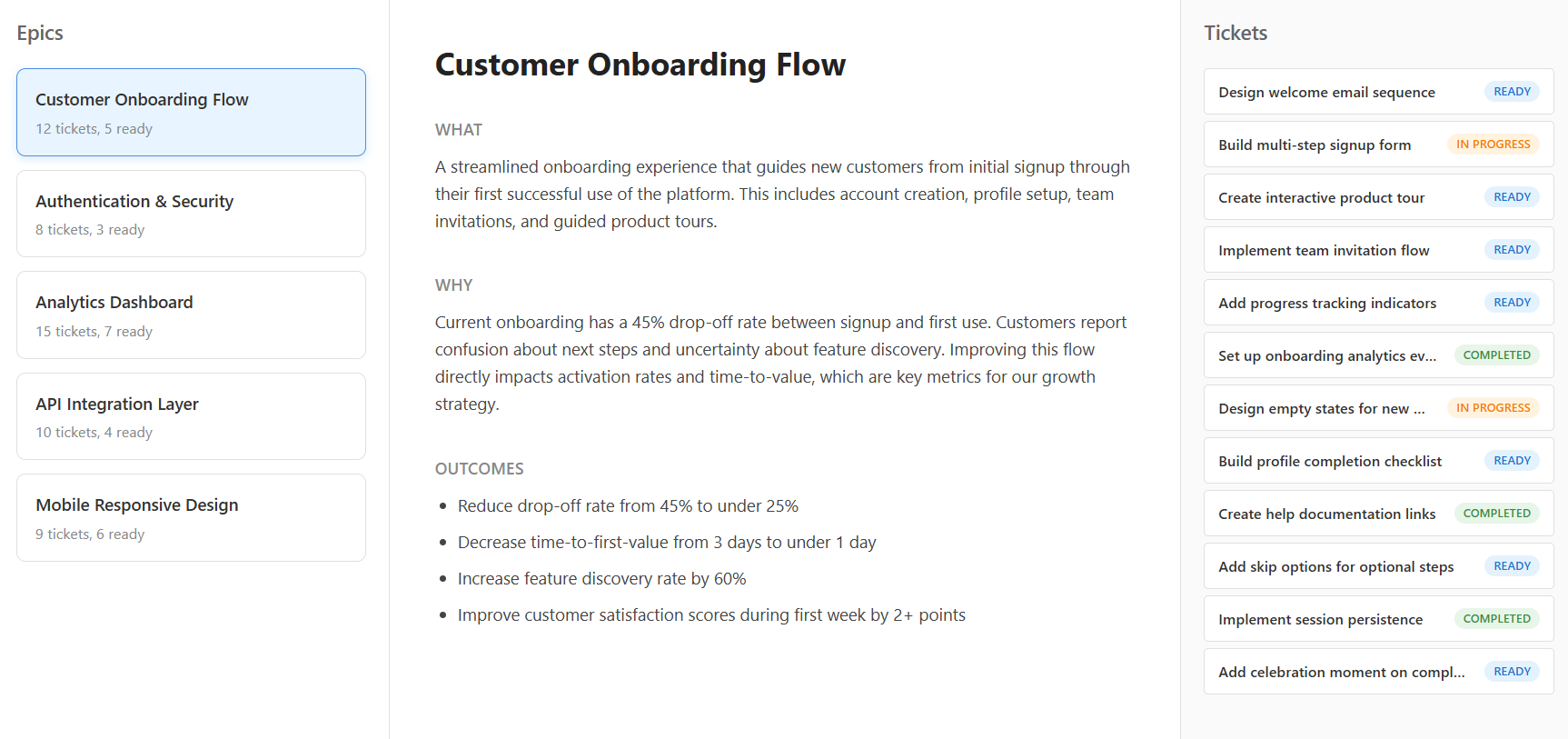
Epic Focus
What your Epic should really be
One epic. All outcomes. All focus. We use AI and ML to extract outcomes, impact, and the "why" - whether you have it there already or not. You need to see the definition of done.
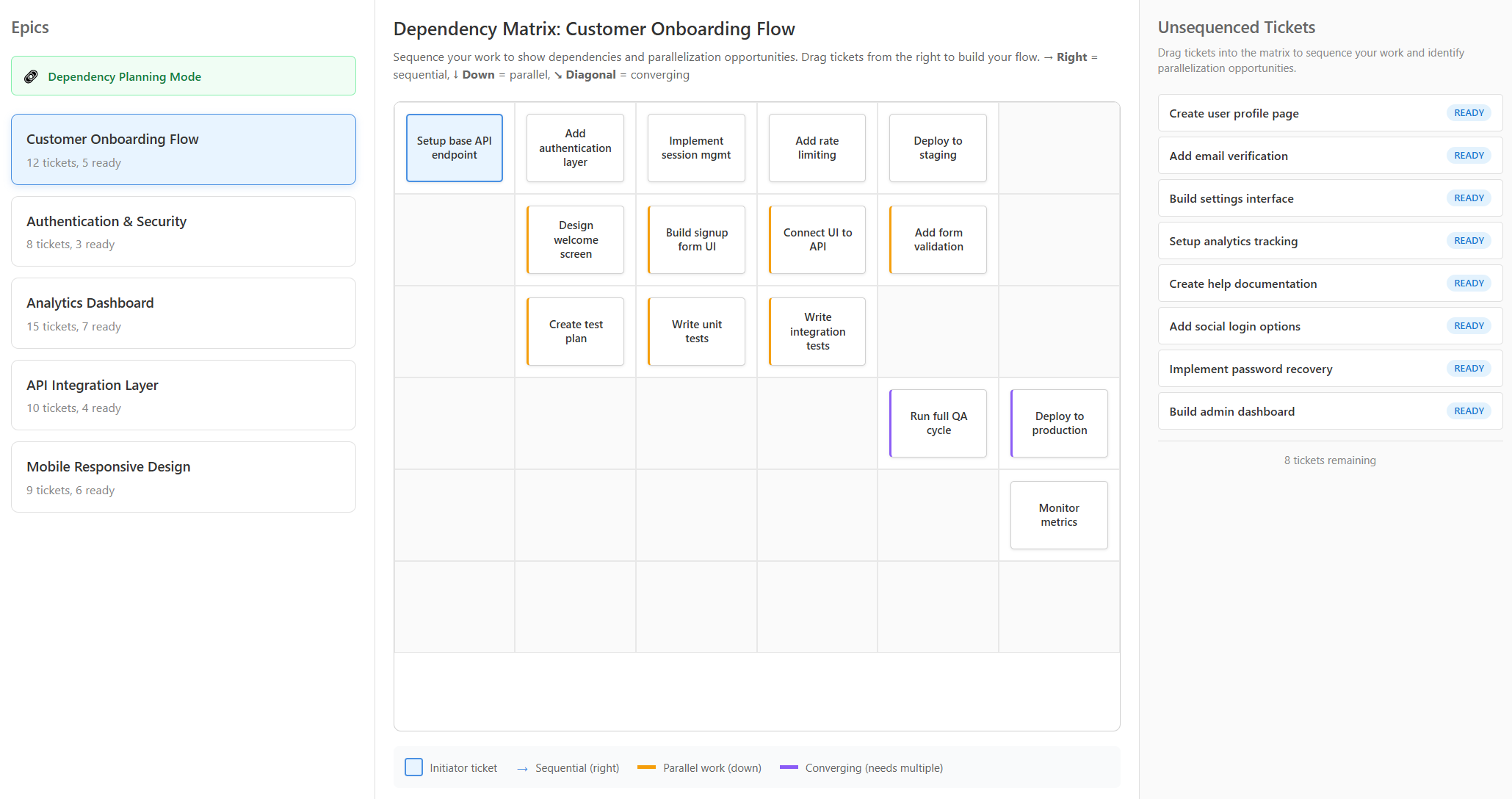
Dependency Planning
Because everything always goes in order?
Blockers aren't the only relationship. Some work is sequential. Some is parallel. Some converges. Now you can see all of it.
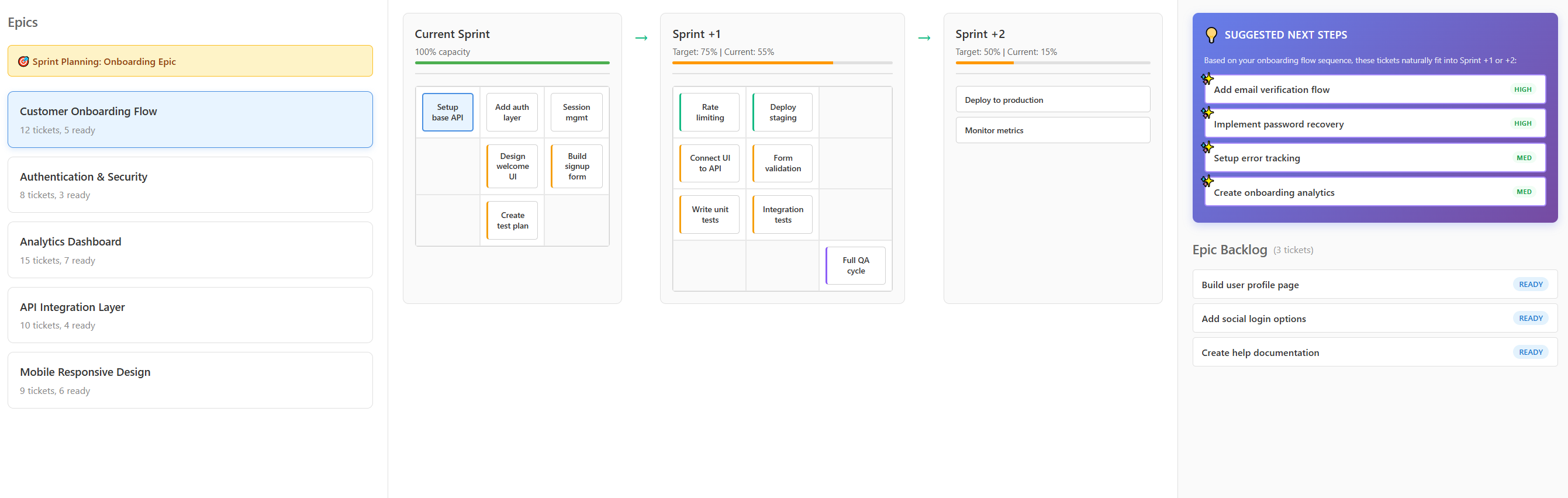
Sprint Planning
Beyond the next 2 weeks
Plan with continuity, not from scratch. See your targets, get AI suggestions for what comes next, and stop treating every sprint like day one.
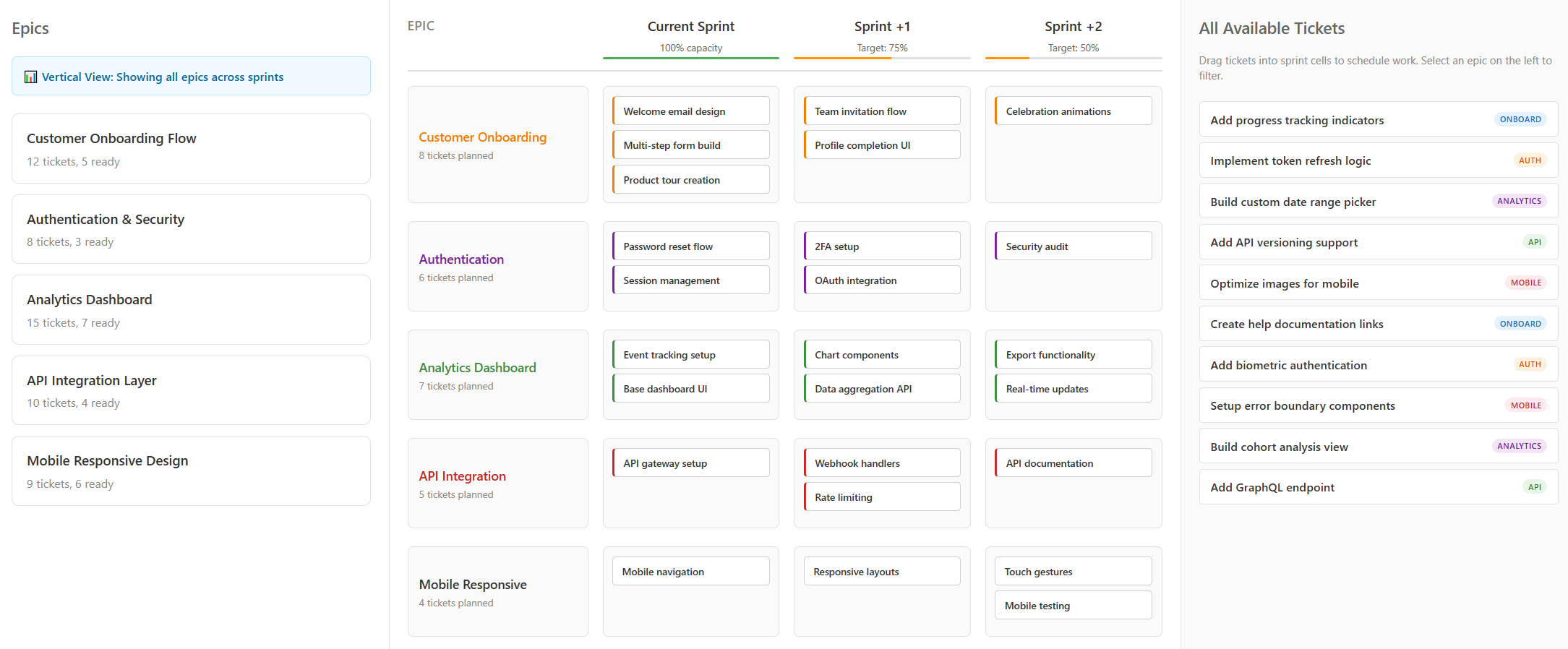
Portfolio View
All epics. All sprints. One view.
See all your epics across all sprints. Catch overallocation before you commit. Know if you can actually deliver.
Product Roles
VP Product, Product Manager, Scrum Master, Senior PO, Product Designer
Are you experiencing these problems?
- Sprint planning feels like starting from scratch every two weeks
- You organize tickets by epic but engineers still ask "how does this fit together?"
- You spend meeting time figuring out what's related instead of planning execution
- Engineers lose track of the bigger picture and you repeat context constantly
- Stakeholders ask "what are we building?" and you struggle to summarize beyond ticket lists
- You know roughly what should come next but have no easy way to communicate it
- Your roadmap is clear but the path from roadmap to sprint is fuzzy
Engineering Roles
Engineering Manager, Tech Lead, Senior Developer
Are you experiencing these problems?
- Sprint planning meetings run long because you're figuring out dependencies on the fly
- Engineers ask "what's the context?" before they can estimate work
- You see resource conflicts too late and scramble to rebalance workload
- Technical dependencies aren't visible until someone asks "wait, who's building that?"
- You spend time explaining how work fits together instead of planning how to build it
- Your team ships tickets but leadership can't see what you've accomplished
- You know what's coming but engineers are surprised by what lands in the sprint
The Problem
Where does VenturiBase fit in your toolchain?
You already have tools for roadmaps and tools for delivery. VenturiBase bridges the gap.
Roadmap Tools
Aha!, Productboard,
Product Discovery
VenturiBase
Epic clarity, sprint planning,
work sequencing
Delivery Tools
Jira, Azure DevOps,
Linear, Asana
Roadmap tools help you plan what to build. Delivery tools track who does what. But how does work flow from strategy to sprints? That's the gap.
The Reality
Right-sized for your team
SAFe is too heavy. Jira alone is too light. VenturiBase is just right.
Too Heavy
SAFe / PI Planning
2-day events, RTEs,
100+ person orgs
Too Long
Roadmap Tools
Annual planning
VenturiBase
Right-sized
Too Short
Delivery Tools
Sprint-level
Too Light
Jira / ADO Alone
No forward view,
sprint-to-sprint only
Progressive Planning
Meet your team where they are
See where your team is today. See what the next level unlocks. Progress when you're ready.
Planning Coverage
Sprint
+1
+2
Example: 100/75/50 means current sprint is fully planned, next sprint 75% planned, sprint after 50% planned
1Reactive | 2Stable | 3Aware | 4Proactive | 5Strategic | |
|---|---|---|---|---|---|
Planning Coverage | ~80/0/0 | 100/0/0 | 100/50/0 | 100/75/50 | 100/100/100 |
Epic clarity | Epics = ticket buckets | Epics as categories | Epics have outcomes | Epics drive decisions | Epics = value streams |
When you catch conflicts | Mid-sprint | Sprint start | ~1 sprint early | 2+ sprints early | At PI Event |
Stakeholder confidence | "Hope we make it." | "This sprint looks fine." | "Getting clearer now." | "Here's our 6-week plan." | "We own the timeline." |
Planning meetings | Reactive, often long | Focused on current sprint | Starting to look ahead | Efficient, forward-looking | PI-style planning events |
Unplanned work impact | Derails the sprint | Manageable disruption | Absorbed in +1 sprint | Planned buffer exists | Rare, handled at next PI |
Typical profile | Sprint-only focused teams | Teams with solid sprint discipline | Teams with emerging visibility | Teams with mature planning | Enterprise / SAFe orgs |
A lot of teams are at Level 1 or 2. That's not a problem - it's a starting point or can be enough. VenturiBase shows you your actual level and helps you progress when you're ready, not when we tell you to.
Real Examples
Where teams use VenturiBase
Engineering Team at a Growth Startup
Why it fits: Productboard tells them WHAT to build this quarter. Jira tracks WHO is doing WHAT today. VenturiBase helps them sequence epics, plan 3 sprints ahead, and connect the dots.
Product Team at an Established Company
Why it fits: Aha! helps prioritize features. ADO tracks tasks and sprints. VenturiBase translates features into sequenced work and gives the team forward visibility.
Engineering-Led Team (No Dedicated PM)
Why it fits: They don't need heavyweight roadmap tools. Engineers own planning. VenturiBase gives them structure to plan epics, sequence work, and see 3 sprints ahead.
At a Glance
How we compare
| Feature | Jira / ADO | VenturiBase | Roadmap Tools | SAFe Tools |
|---|---|---|---|---|
| Sprint Planning | ⚠Basic | ✓Enhanced | ✗ | ✓Complex |
| Epic Organization | ⚠Categories | ✓Work Flows | ✓Strategy | ✓Features |
| 3-Sprint View | ✗ | ✓ | ✗ | ✓PI Planning |
| Setup Time | Instant | 2 minutes | Days | Weeks |
| Team Size | Any | 10-15 | Any | 50+ |
| Learning Curve | Low | Low | Medium | High |
Try it in your next sprint planning.
Connect Jira. See your epics organized. Run one session.
If it doesn't make your job easier, don't pay for it.
14 days free • No credit card • Cancel anytime